Retro Rock

Over the years, there have been many bands who play like they don’t know the 60’s ever came to an end. This is great news.

On most stops along my magical musical tour, I’ve listed Known For for each band, to remind the reader where they might have heard of the bands before. But most of these bands are not known for anything, at least that I’m aware of. So I’ve replaced that with a Sounds Like, to give you a clue of who else they might remind you of.

These are “my” bands. The bands that helped shape who I am, roughly in order of how much they mean to me.

Dave Mattingly: The Musical, Part 15

Garage Rock

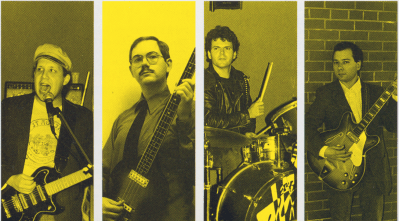
  • Mystic EyesMystic Eyes
    • Sounds Like: The Animals, Van Morrison/Them, Sweet, The Standells, MC5
    • Memories: The first song I heard from Mystic Eyes was “From Above” back in 1986. I thought that the singer, Bernie Kugel, sounded like Elmer Fudd with a cold (and I mean that in the best way possible), and loved him for it. The first line of their opening track, “she’s got a reason” sounds a bit like “she’s got a weasel”, which makes She Don’t Cry No More even more fun. In 1993 or so, I was on a business trip to Pittsburgh, and got to town a day before my conference, so I stopped by Get Hip headquarters, the label that produced their albums. It was great to meet the folks there, and pick up the band’s second album (that I didn’t even know existed).
    • Favorite Songs: From Above, Calm Me Down, I Lost My World, She Don’t Cry No More, I Believe You, I Can Only Give You Everything
    • Links: There’s a great retrospective here and their whole first album here.

Surf PopGuantanamo Baywatch

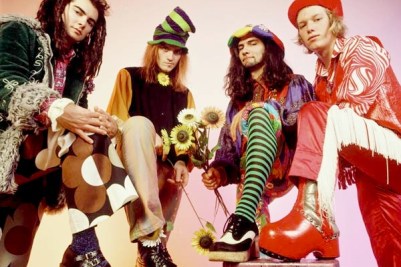
Psychedelic Rock

Girl Power Pop

Go back to Part 14: Halloween Music or on to Part 16: Love Songs


Cool Job: Wire Tranfer

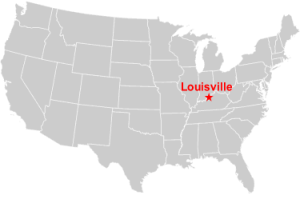
I’ve done a lot of things for a living over the years, and after working with a number of short-lived startups and a large corporation in Louisville, I left town for a new start.

Cool Job, Part 5: Wire TransferWire

A recruiter friend of mine found a job for me. This was before the internet had revolutionized our daily lives, so recruiters were a great way to find something, especially out of town.

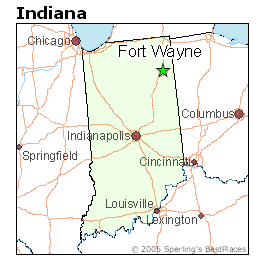
The job was at Essex Group in Fort Wayne, Indiana. That’s the northeastern corner of the state, around 250 miles away from Louisville (four hours on the road… barring traffic, construction, or weather).

Essex is a wire manufacturer, with several brands around the world. They’d bring in various metals, and turn it into long spools of wire, sort of like a giant Play-Doh Fun Factory, but with more metal.

Be Excellent to Each OtherFort Wayne

My job was to build an EIS (Executive Information Summary) system. EIS was the precursor to Business Intelligence (BI, sometimes called dashboarding). The goal was to take all the data from all the departments from all the locations, roll it up into drill-downs, and highlight areas that need attention from the bigwigs.

This would help them find problems that arose (with any luck, even before they arose), like:

  • we’re almost out of inventory item XYZ123, which we need to make this thing over here that makes us a lot of money
  • this location’s so-and-so division is almost two weeks behind on their critical project, which will jeopardize all these other things
  • four of our ten managers are shorthanded by over 20% in whatever job
  • the market price for one of our supplies is going up in a hurry
  • …and stuff like that

Boss: “Are you good at PowerPoint?”
Me: “I Excel.”
Boss: “Was that Microsoft pun?”
Me: “Word.

Until this job, I had really only written software. I learned a lot about data management and reporting from this job.

In fact, I still do a lot of this kind of thing, but using very different technologies and techniques. Turning “facts” into “information” into “action” is still highly useful.

What a Data be Alive

Once I had gotten a good grip on using Excel to pull data from the mainframe and SQL databases, and worked my magic on it, I took a strong interest in the data itself. How was it organized? How did it get in and out? When did it go in? Who put it there? What did it really mean? How did we know it was correct?

I spent a lot of time hanging out with the DBA (DataBase Administrator) team, and learned from them. Before too long, I didn’t have to rely on them to get the data I needed — I got it myself, and cleaned/joined/moved it the way I needed it to be.Data Box

Fun Stuff

While in Fort Wayne, I got involved with the local gaming convention, took over as editor-in-chief of Haymaker APAzine, drove to my first GenCon (in Milwaukee), saw They Might Be Giants in concert at the Wooden Nickel record shop, and found a church I really liked (after trying probably thirty others).

After I left, I missed out on the people voting for an inside joke — to name their new government center after former mayor Harry Baals. But the city officials wouldn’t go for it. As NBC reported: Scratch “Harry Baals” off list of names for government center. Buzzkill.

Home Again, Home Again, Jiggety Jig

I loved my job. I was learning great stuff, and kicking butt while doing it. I was getting paid nicely. But we had just had our first son, and two of my brothers were also have their first kids (one was born just three days after my boy), and I wanted these young cousins to grow up together.

So I used my newfound database skills, and took a job as a Database Administrator back in Louisville.

Go back to Part 4: Corporate Agent or on to Part 6

The World Around Us

I’m a Christian, and sometimes a teacher/preacher.Louisville

This lesson looks outside the church, to America and the world as a whole, then brings it back home.

People Around Us

Depending on which statistics you look at, and how they were counted, the population of the US is between 250M and 500M. Let’s go with 250M for now.

Here’s how my state and city compare to the country at large.

Place Population Relative
US 250,000,000
Kentucky 4,000,000 (1½% US)
Louisville (city limits) 250,000 (6½% KY, 0.1% US)
Louisville (metro area) 1,250,000 (30% KY, ½% US)

My city’s metropolitan area amounts to half a percent of the entire country. Not too bad, for a “big small town.”

Louisville! Nazareth! Can anything good come from there?” (John 1:46)

Half the US Population

Half of the people in America live in the 39 most populous city areas.

The other half are spread out over the entire rest of the country.

People We Know

This varies a lot by personality, job, age, region, and such, but here are some broad averages of the people we know.

Relation People
See 80,000
Meet 10,000
Acquaint 1,000
Friends 150
Close 10

And most Americans these days move around a bit, too, which helps to expand the pool of people we meet.

Moves
Jobs 10
Homes 12
Churches ?

I know more people than that (and have worked more jobs than that). Part of that scope comes from me working at a lot of places, but most comes from my wide variety of interests and activities. I’m fairly involved in the circles of technology, business, arts/theater, and church, and belong to many groups inside each of those areas.

Church Sizes in America

Churches around the county vary in size, with most of them serving fewer than 100 people on a weekly basis.

Size Churches Total Weekly Attendance
<100 150,000 9,000,000
<500 100,000 25,000,000
<1,000 12,000 9,000,000
<2,000 6,000 8,000,000
<10,000 1,000 4,000,000
>10,000 50 1,000,000
Total 300,000 56,000,000

Pew Research300,000 churches account for 56 million people each week. That’s a lot of church attendance.

* These figures account for Christian Protestant (non-Catholic) churches

100 Americans

These numbers are still fairly large, and not easy to grasp.

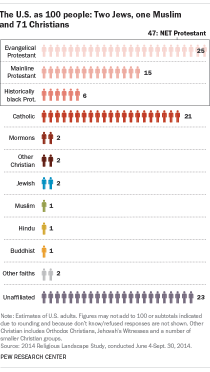
Let’s boil it down, and pretend that the entire US is only 100 people. If you’re in a room with 100 people, you can imagine each person filling one of these categories.

Numbers taken from Pew Research.

Religion People
Christian 69
Mormon 2
Jewish 2
Muslim 1
Hindu 1
Buddhist 1
Other 2
None 23

The Christians are comprised of these people:

Religion People
Catholic 21
Evangelical 25
Protestant 15
Black Protestant 6
Other Christian 2

As you can see, there are a lot of Christian in America.

From what we often hear on the news, it might not always sound like it.

I was a bit surprised to find out that out of 100 people, only two would be Jewish, and only one Muslim.

World Around Us

Let’s look at that first set of numbers again, but add in the rest of the world.

Place Population Relative
World 7,400,000,000 (30x)
US 250,000,000 (3%)
Kentucky 4,000,000
Louisville (city limits) 250,000
Louisville (metro area) 1,250,000

The rest of the world is 30 times larger than the US; the US is just 3% of the world population.

This time, let’s pretend that the whole world is 100 people, not just the US.

So, where is everybody?

Numbers taken from 100 People.

Continent People
Asian 60
African 16
American (North and South) 14
European 10
Australia 0

What do they speak?

Language People
Chinese 12
Spanish 6
English 5
Hindi 4
Arabic 3
Bengali 3
Portuguese 3
Russian 2
Japanese 2
Other 60

(The languages don’t add up to 100, since many people speak more than one language.)

The Bible has been translated into 2,500 languages. That’s quite a lot, but there are 7,000 languages spoken in the world today.

Other ways of looking at us :

Factor People
Read/Write 86
College 7
Internet 45
Safe Water 91
Shelter 78
Overweight 22
Underfed 11
Starving 1

Out of 100 people in the world, 9 have no water, 1 has no food, and 22 have no shelter from the elements.

We’ve already looked at the religious counts in the US. Here’s how it looks worldwide:

Religion People
Christians 31
Muslims 23
Hindus 15
Buddhists 7
Other 8
None 16

The international landscape is a lot different than what we’re used to here in the US.

People Around Us

That’s all a fine intellectual exercise, but let’s bring it home and make it personal.

Taking the national averages of 69 out of 100 Americans being Christian, and applying it locally, we get:

Place Population Christian Lost
US 250,000,000 170,000,000 80,000,000
Kentucky 4,000,000 2,500,000 1,500,000
Louisville (city limits) 250,000 170,000 80,000
Louisville (metro area) 1,250,000 850,000 400,000

FriendsThere are roughly one and a half million non-Christians in Kentucky. Close to half a million in the metro area.

People who need the Lord aren’t just “out there” — they’re here in our own neighborhoods.

People We Know

To bring it one more step closer to home, if we do the same thing to the number of people that we know:

Relation People Christian Lost
See 80,000 55,000 25,000
Meet 10,000 7,000 3,000
Acquaint 1,000 700 300
Friends 150 100 50
Lost 10 7 3

It’s those final two numbers that particularly draw my attention.

On average, each of us has 50 friends and 3 close friends that don’t know the Lord.

We can’t individually bring the gospel to the world, but even if we could, the world wouldn’t listen to us. But we each have dozens of people that will listen to us, that might not listen to anyone else.

In my case, the stakes are even higher. I know more people than average, and I intentionally have a higher percentage of non-Christians, by putting myself into new situations and stretching my comfort zone as far as I can.

Discuss

  • How many people do you know fairly well?
  • How many are non-Christians?
  • How much time do you spend with them?
  • How can you reach your 50+3?
  • If you don’t have any 50+3, should you? how?

Download

You can download the PowerPoint slides here.

LouieLab

LouieLab opened on December 1, 2016.Louie Lab

LouieLab

It’s a new collaboration between Louisville government and the people. It’s designed for use as a coworking space, so government and people can work on specific projects together, like the Civic Data Alliance‘s hackathons through Code for America.

At the opening, two tech projects were demonstrated:

  • Smart Louisville, the city’s next-level open data interface
  • CASPER, the smoke alarm detector with a built-in 3G signal

Smart Louisville

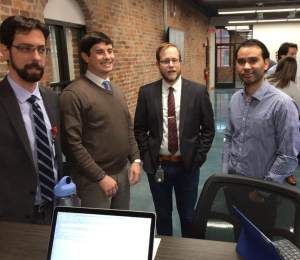
Smart Louisville TeamVolunteers from the Civic Data Alliance built the interface between Amazon’s Echo Dot (“Alexa”) and various city data interfaces (“APIs”).

I was a (minor) part of the team that put all of this together. Most of the work was done by Reydel Leon, with lots of input from Michael Schnuerle (the city’s first Data Officer), Ed Blayney (who just won a Navigator Award for his work on SpeedUpLouisville), Matthew Gotth-Olsen (who manages LouisvilleKY.gov, and was once in a hardcore band), and others.

As it turns out, the most common 3-1-1 call is to find out about junk pickup day. Soon, anyone in Louisville with a Dot can just ask it, “Alexa, when is junk pick up day?”

The volunteers also have developed the interface to programmable light bulbs that can change color and intensity based on pre-selected options. That way, for example, the bulb could:

  • turn yellow to warn allergy sufferers during high pollen days
  • flash red during a tornado warning
  • flash through a full cycle of colors in time to a dance beat (although my theoretical ‘disco mode’ seems unlikely to ever get developed)
  • …and many more, in fact, the city would love to hear your ideas on useful interfaces

Where There’s SmokeCASPER

CASPER (the Completely Autonomous Solar Powered Event Responder) was developed by local makers Nathan Armentrout, James Gissendaner, and David Jokinen at the LVL1  smoke alarm hackathon a year ago. It listens on the standard smoke alarm frequency band (so that it should work with any variety), and makes a wireless call to alert the authorities. It’s primarily in use right now at vacant and abandoned buildings, since fires at a vacant building spreads to neighboring properties 80% of the time. The city of Louisville has several in use now, and plans to roll out many more. Other cities are also expressing interest.

News RoomLouie Lab Group

Here is some press coverage of the opening:

Other Nifty Tech Stuff

Here in Louisville, we’re also founding a chapter of the VRARA (Virtual Reality / Augmented Reality Association). We had dozens of people at the kickoff meeting last week.

Warp Zone, our video game creating coworking space, just had another successful Ludum Dare game creation weekend.

The KY Science Center just ran another three-day Celebration of Coding event, aimed at getting youngsters involved in software.

Costumes in the Bible

MaskI’m a Christian, and sometimes a teacher/preacher.

Some of you may know that Christmas really isn’t my favorite holiday, so here’s another Halloween-themed one. 🙂

This sermon talks about the various costumes and disguises that have appeared in the Bible — there are more than you might expect.

Costume Tricks

Many times, costumes were used underhandedly, to trick people.

You may remember Jacob and Esau, the brothers with very different lives and physiques. Esau was the outdoorsman, and has his father’s approval. Jacob was the quiet type, and stayed close to mama.

Rebekah took the best clothes of Esau her older son, and put them on Jacob. She covered his hands and the smooth part of his neck with goatskins. (Genesis 27:15-16)

Rebekah tricked her blind husband Isaac into giving most of his inheritance to the wrong son.

But two can play at that game. Years later, Jacob met the girl of his dreams, and worked for her father for seven years in exchange for marrying her. But Laban pulled the old switcheroo on him.

Jacob said to Laban, “Give me my wife Rachel.” But when evening came, Laban took his daughter Leah to Jacob. (Genesis 29:21-23)

Not so fun now, is it, Jacob?

But he didn’t necessarily learn from that experience, either. Years later, he has a son he liked more than the rest, and he dressed him in weird clothes.

Jacob loved Joseph more than all his children, and made him a coat of many colors. When his brothers saw that their father loved him most, they hated him. (Genesis 37:3-4)

His jealous brothers used that very coat as a terrible disguise to break their father’s heart and to cover up their own treachery.

They dipped Joseph’s coat in goat’s blood, and told their father, “We found this.” He recognized it and said, “Some ferocious animal has eaten him!” (Genesis 37:31-33)

Eventually, Joseph gets promoted to the top of the slave totem pole, and practically runs Egypt. When his brothers came to ask for food during a famine, they didn’t recognize their brother, so he took advantage of the situation.

Joseph recognized his brothers, but he disguised himself. He accused them, “You are spies! You have come to see where our land is unprotected.” (Genesis 42:7-9)

What’s good for the goose, eh, brothers?

Moving away from that family tree, we look at an even weirder one. Tamar tricked her own father.

Tamar disguised herself as a prostitute, and Judah slept with her. She took his seal and cord as a pledge for payment. (Genesis 38:14-18)

She used that seal and cord to blackmail him. Two wrongs still don’t make a right.

And finally, king Saul disguised himself to hide his own wrongdoing.

Saul disguised himself, and went to the seer in the dark of night. He asked her to consult a spirit. But the woman said, “Saul has cut off mediums from the land.” (1 Samuel 28:7-9)

That ain’t right, Saul.

Costume TreatsGroucho

But costumes and disguises have been used for good, as well.

We are encouraged to “wear” godliness.

I will rejoice greatly in the Lord, My soul will exult in my God; the Lord has clothed me with garments of salvation and a robe of righteousness. (Isaiah 61:10)

I put on righteousness, and it clothed me; justice was my mantle and turban. (Job 29:14)

And to use it for protection.

Put on the whole armor of God, that you may stand against the schemes of the devil. (Ephesians 6:10)

Wearing love can cover up evil.

Most important of all, continue to show deep love for each other, for love will veil a multitude of sins. (1 Peter 4:8)

The Almighty doesn’t care about the latest fashion trends.

The Lord does not look at the things people look at. People look at the outward appearance, but the Lord looks at the heart. (1 Samuel 16:7)

Even Jesus wore a disguise.

Jesus himself came up and walked with them, but they were kept from recognizing him. When their eyes were opened, he disappeared from sight. (Luke 24:15,31)

Of course, it was a miraculous thing, possibly similar to the transfiguration, but it’s kind of funny to think of Jesus removing a set of Groucho glasses at the end of a long walk with his friends.

But our words hold the power of life and death, and those words will remove all costumes.

A good man draws good from the good in his heart; an evil man draws evil from the evil in his heart. For from the overflow of the heart the mouth speaks. (Luke 6:45)

There’s no hiding from our true selves.

Costume Warningsghost

Besides costumes in the past, there are more on the way, and many will not be used for good.

Beware of the false prophets, who come to you in sheep’s clothing, but inwardly are ravenous wolves. (Matthew 7:15)

There are some who pretend to be rich, yet have nothing. There are some who pretend to be poor, yet have great wealth. (Proverbs 13:7)

When Jesus comes back, he’ll be wearing some serious duds. Beware, evildoers.

The Lord wore the breastplate of righteousness, and helmet of salvation. He wore vengeance for his garment, and zeal as his cloak. Righteousness is his belt, and faithfulness his sash. (Isaiah 59:17, 11:5)

We have to be careful ourselves, even in the church.

Watch out for the teachers who wear flashy robes to get respect in public, and take the best seats at church. They mask their evil by making long prayers. (Mark 12:38-40)

Enemies disguise themselves with their lips, but in their hearts they harbor deceit. (Proverbs 26:24)

But we must know ourselves and repent, to truly know God.

We are all infected and impure with sin. Our righteous deeds are nothing but filthy rags. (Isaiah 64:6)

Costume PromisesHero

Jesus had (and will have) even more costumes.

This is the one that makes the rest possible.

Christ Jesus made himself nothing, by taking the very nature of a servant, being made in human likeness. (Philippians 2:7)

He became not just a mortal being meant to die, but a servant.

And he continues to hide among us, or close enough.

I was hungry and you fed me, thirsty and you gave me drink, a stranger and you welcomed me, naked and you clothed me, sick and you tended to me, in prison and you visited me. (Matthew 25:35)

His sacrifice granted him authority as Judge over all.

He wore a garment soaked with blood, and his name is called The Word of God. (Revelation 19:13)

And his own blood also covers us, and extends his righteousness to those who believe in him.

Her household has no fear; for everyone is clothed in scarlet. Though your sins are like scarlet, they shall be as white as snow. (Proverbs 31:21, Isaiah 1:18)

Discuss

  • How have you ever been misled?
  • How do you react?
  • How do you form your opinions of someone when you first meet?
  • Based on your “costume” (actions, words), who do people think you are?

Download

You can download the PowerPoint slides here.