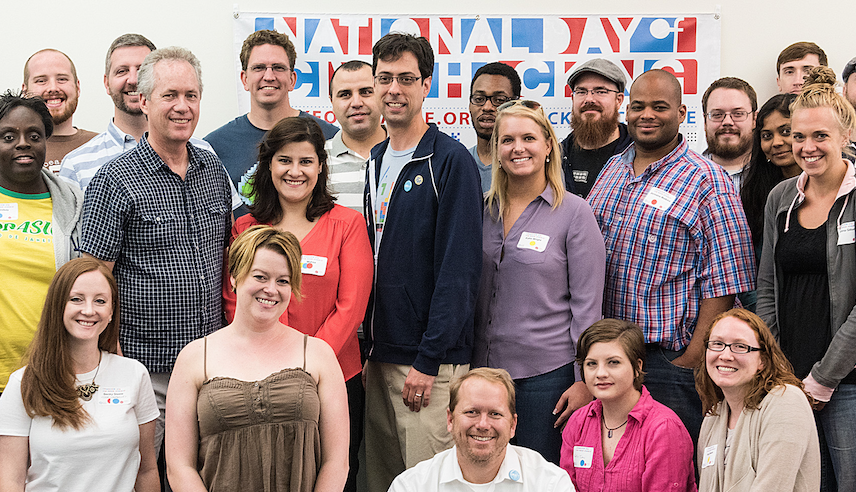
 Students from the University of Louisville hosted DerbyHacks 2.0 on February 24-26, 2017 at the Institute for Product Realization complex, overlapping into the Engineering Garage, the Advanced Manufacturing Competency Center, and FirstBuild.
Hackathon
DerbyHacks isn’t the same kind of hackathon as the Open Data Day Public Safety Hackathon. This one is a three-day competition under the auspices of the Major League Hacking network.
I attended this hackathon as an observer/advisor, not as a competitor. I love the hackathon spirit and atmosphere; the innovation energy inspires me.
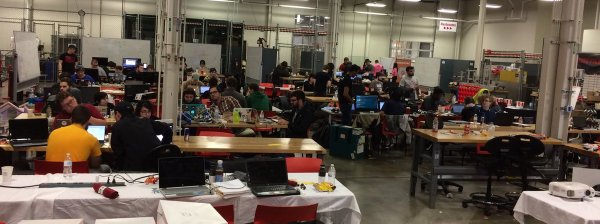 Over a hundred students from Kentucky colleges got together to create cool stuff. I’d guess that half the students were from UofL, where the event was held, but there were several from the University of Kentucky, from Berea College, and others.
Some of the teams created physical products, and others created digital ones.
Resources
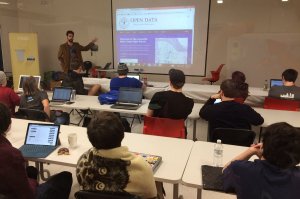 There were several sponsors, presentations, mentors, tools and parts, and so so much food.
Experts from the region came to offer tips and troubleshooting to the teams.
The city’s Chief Data Officer, Michael Schnuerle (right), talked with several teams about Louisville’s Open Data Portal, and the myriad of ways that it could be used.
Teams
The full list of 26 teams is here, with the winners at the top (look for the diagonal yellow “winner” stripes).
Knowing several astrophysicists, I was quite impressed with CenterScope, that automatically centers your telescope on a star you want, without you having to manually fiddle with the delicate calibration knobs.
It was cool to see Alexa used for Smart Chess by letting you speak your move, with a synchronized electromagnetic chess board would move the piece on your board and on your remote opponent’s board. Your opponent would then speak his move, and so on.
 A bunch of my friends formed the LouTrail team to recommend local restaurants and attractions. They won a special award for best use of local data.
Silent City combined the input from (proposed) sonic detectors throughout the city to map the noise pollution, much like Air Louisville did for the air quality (cleverly syncing asthma inhalers with a smartphone gadget to “phone home” when it was used, to identify to parts of town that were hardest on the lungs).
New Home for Me combined data for crimes and a dozen other sets with real estate listings, to help home buyers find a place that really fits their needs.
Physical Threat Intelligence used facial recognition technology as a “key” to grant access (and potentially other tasks).
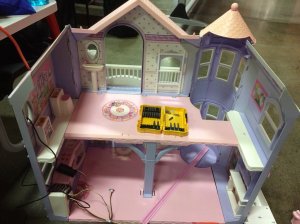
The Smart Dollhouse was lots of fun. The team wanted to work with “smart home” technology, but since they couldn’t bring an actual house with them, they brought a tiny one. They installed cameras, motion sensors, heat sensors, and app-controlled door locks. Since the dollhouse had an elevator, which was broken, they fixed it! And also tied that to a smart app. It won the award for most potential value / biggest market.
 The big winner was SnapCal, led by my friend Ishwar Agarwal, an app that uses pictures of your food to determine the calories. It sounds simple, but took a lot of computer know-how to pull off, using Machine Learning to translate an image into a food, then displaying the nutritional information. Besides being technically challenging, I think it reflects the health and fitness focus of today’s youth.
The Future
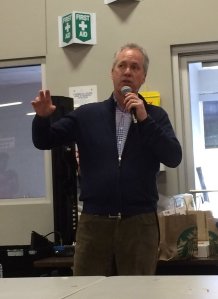
Since Louisville’s Mayor Greg Fischer was an entrepreneur himself (behind the combined soft drink / ice dispenser), he loves coming to hackathons, especially ones that are student-led and student-competed. Our future is in good hacky hands.

 Dave Mattingly